Many people imagine led wall virtual production as one large flat screen behind the actors. That can work well for interviews, product shots, and simple background replacement. However, more advanced virtual production spaces often use curved walls, corner sections, side walls, ceiling pieces, or floor LED panels. These shapes create an LED volume, not just a backdrop. The goal is to give the camera, actors, and lighting more believable spatial relationships.
A flat wall can limit camera movement. If the camera turns too far to the side, it may reveal the edge of the screen or break the illusion of depth. A curved wall extends the virtual environment around the subject, giving the director more freedom for pans, tracking moves, and wider lenses. Curved surfaces also help with reflections. When shooting vehicles, glossy products, helmets, glass, or metallic props, the object reflects more of the virtual world instead of reflecting a hard screen edge.
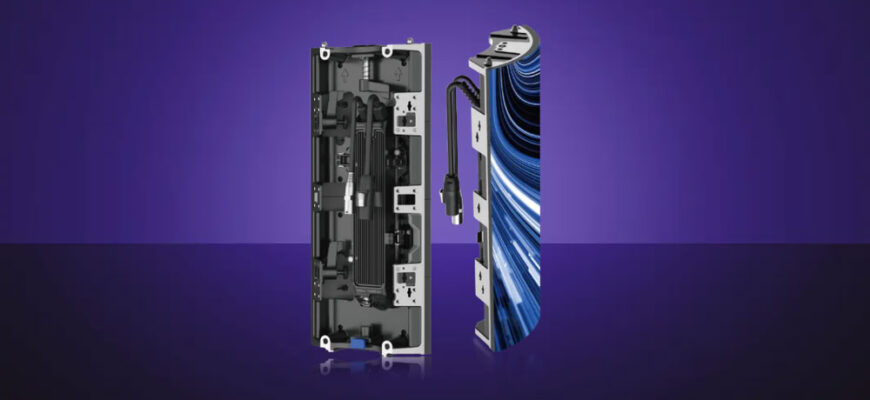
Corners are especially important in small studios. A 90-degree corner can make a compact stage feel larger, but it must be designed carefully. A sharp seam, mismatched color, or incorrect content perspective can become visible on camera. Products such as the E-Corner 90 flexible LED panel are designed for 90-degree flexible and creative rental applications, helping teams build small-radius corner structures, column shapes, and mixed configurations that would be difficult with standard flat panels.
Curved walls also influence content design. A background that looks correct on a flat screen may stretch or distort when mapped across a curve. The virtual art department should know the physical wall dimensions, curve radius, pixel count, camera positions, and safe shooting area before preparing the scene. In some cases, the content should be rendered specifically for the wall shape. In other cases, the wall may be used mainly for light and atmosphere, with less emphasis on precise perspective.
For indoor creative stages, the E-Swan curved rental LED display supports curved and wave-like configurations, which can help studios create more immersive environments for music videos, training labs, brand events, and virtual production tests. The ability to mix flat and curved sections gives designers more options when space is limited or when a stage must serve multiple production types.
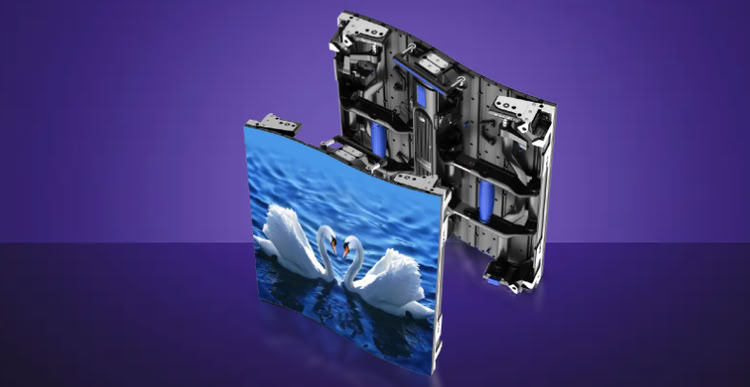
The main challenge is that complex shapes require better planning. A curved LED volume affects power distribution, signal routing, structural safety, content mapping, camera tracking, and maintenance access. It also changes lighting behavior. A wall that wraps around the actor can provide beautiful ambient light, but it may also reduce contrast if the cinematographer does not control spill. Lighting and screen brightness must be balanced together.
Producers should begin with the shot list. If the production mostly needs locked-off interviews, a flat wall may be enough. If it needs moving cameras, reflective products, immersive environments, or dramatic wide shots, curved or corner sections may add real value. The design should be justified by camera language, not by visual complexity alone.
A useful planning method is to draw the camera envelope before drawing the wall. Mark where the camera can travel, where actors can stand, where props may reflect the screen, and which areas will never appear in frame. This often reveals that the most valuable LED surface is not always the widest one. A side return may matter more than extra height. A small corner may solve a reflection problem better than a larger flat background. A ceiling piece may be useful for a car roof but unnecessary for interviews. Designing from the camera envelope keeps the stage practical and prevents decorative complexity from consuming budget.
The production designer should be involved early as well. Physical props, floor texture, practical lights, and foreground set pieces help connect the actor to the virtual environment. A curved wall can create depth, but the illusion becomes stronger when the physical set shares color, texture, and direction with the digital scene. Even a small amount of real foreground detail can make the LED volume feel much larger.
This is why stage drawings should include both physical and digital elements. The wall shape, virtual scene, floor treatment, practical light positions, and actor marks should be reviewed together. If these pieces are planned separately, the final image may feel disconnected. If they are planned as one environment, even a compact LED volume can produce convincing depth.
An LED volume is most powerful when its shape supports the story. Curves, corners, and wraparound surfaces can make a digital environment feel physically present, but only when the hardware, content, camera, and lighting are designed as one system. For teams building a virtual production stage, spatial design is just as important as screen resolution.